
Evaluating Fragrance OEM and ODM Suppliers for a Vegan Brand
Evaluating a fragrance supplier for a vegan brand is a document exercise as much as a factory visit. The claim forces every part of the evaluation to produce evidence — ingredient policy, batch records, label practice, packaging documentation — and a supplier that cannot show the evidence on request will not produce it at volume either. Score against a written criteria list and the decision stops being a gut feeling.
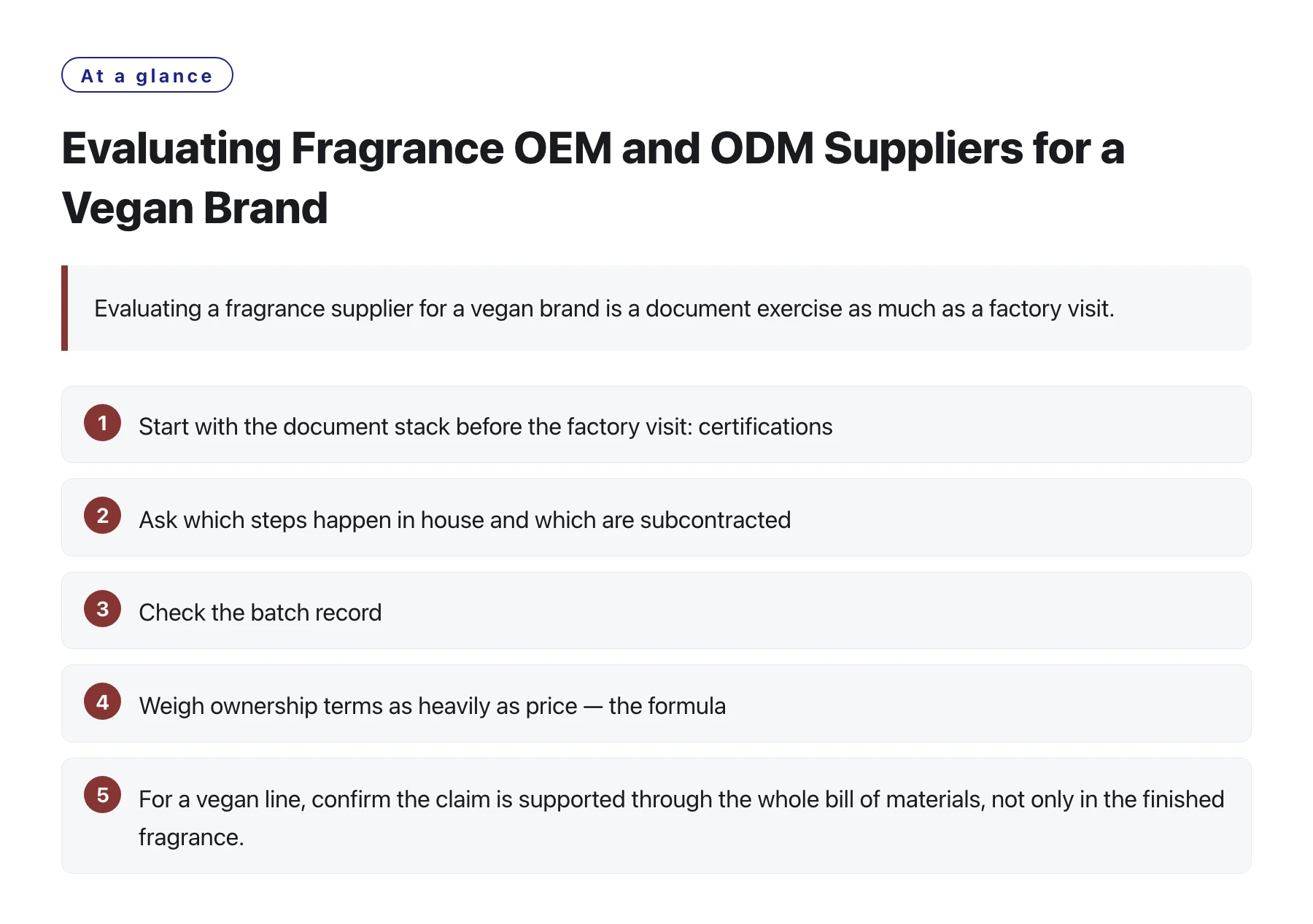
Key takeaways
- Start with the document stack before the factory visit: certifications, ingredient policy and the vegan evidence format tell you more about the relationship than the building does.
- Ask which steps happen in house and which are subcontracted, because every handoff is a point where evidence can break.
- Check the batch record, not just the certificate: certificates show management systems, records show what actually happened on a run.
- Weigh ownership terms as heavily as price — the formula, the mould and the design files decide what the brand keeps when the relationship ends.
- For a vegan line, confirm the claim is supported through the whole bill of materials, not only in the finished fragrance.
Most supplier evaluations start with price and certifications, then stop. Both are necessary and neither is sufficient, because they describe capability rather than behaviour. The evaluation that predicts a good relationship is the one that checks what the supplier does with evidence: how it records batches, how it answers ingredient questions, and how it documents the vegan claim.
The framework below is built for a vegan-positioned brand choosing between OEM and ODM routes, but most of it applies to any fragrance line. It is ordered the way the decisions actually happen: documents first, process second, contract last.
Start with the document stack
Request four documents before any visit: the certification list with certificate numbers, the ingredient policy (which materials are excluded by default), a sample batch record, and the vegan evidence format they can deliver. Requesting them in writing does two things: it tests how quickly the supplier produces documentation, and it sets the expectation that documentation is part of the service.
Certifications describe audited management systems, and the exposure to third-party testing and quality assurance can be helpful context — firms like SGS describe their cosmetics programmes as covering testing and quality assurance across the finished product [1]. But a certificate is a starting point for a conversation; the batch record is where the conversation becomes real.
The four process questions
Four questions separate suppliers that run a process from suppliers that run a promise.
First, what happens in house? A factory that handles fragrance R&D and production itself, under one roof, answers this in a single list — which makes every later audit shorter a factory that handles fragrance R&D and production.
Second, how is a batch recorded? Walk one record from raw material intake to release. If the record exists and is legible, the process is repeatable.
Third, when does the vegan verification happen? The right answer is at ingredient intake, because a claim supported through the whole bill of materials survives an audit while a claim checked only at the finished perfume does not.
Fourth, who signs off a change? Formula, packaging and supplier changes all shift the compliance picture; a written change-control step is the difference between a managed product and an evolving accident.
A weighted scorecard for the shortlist
| Criterion | What to look for | Weight |
|---|---|---|
| Documentation response time | Complete pack within a stated period, no follow-up nagging | 15% |
| Ingredient policy and vegan evidence | Policy in writing; evidence format demonstrated on request | 20% |
| Batch record quality | Legible, complete, tied to batch numbers and dates | 20% |
| In-house scope | Key steps on site; subcontracting named and quantified | 15% |
| Compliance awareness for your market | Knows the specific rules of the destination, not just 'GMO free' platitudes | 15% |
| Contract clarity on ownership | Formula, mould and design files assigned in writing | 15% |
Weights are a starting point, not a law — but score against the same list for every supplier. The undisciplined part of evaluation is comparing suppliers on different questions and calling the result a comparison.
Red flags that are not what they seem
Some commonly cited red flags deserve a second look. A supplier without a published certification list is a question mark, not a rejection — many small factories are compliant but poor at publishing. Ask for the list directly and judge the response. Likewise, 'we use a third-party lab' is a good answer when the lab is named and the reports are shared; it is a problem only when the testing is unverifiable.
A supplier that cannot switch between both OEM and ODM fragrance production is not necessarily weak — it simply means the brand's growth path has a boundary. The evaluation should ask which model each partner is built for, and whether the other model is possible later, because most vegan lines start ODM and mature into OEM.
If the growth path matters, look for a scent development and manufacturing partner that can move from developed bases to owned formulas without changing the documentation system in between — the file continuity is what keeps the vegan claim intact across the transition.
Ownership and the end of the relationship
The last evaluation step is the most expensive to skip: ownership. Industrial designs for the bottle and the packaging can be protected through national registration or through the international design system administered by WIPO, and that protection is only useful if the brand — not the supplier — holds the registration [2].
The same question applies to the formula and the design files. Ask the ownership question in the same meeting as the price; a supplier who hesitates on ownership is telling you something about the next negotiation, not this one.
The evaluation is complete when the supplier has answered the document stack, the four process questions, and the ownership question — and when you have scores on one list for all candidates. If the visit happens before those are answered, the visit is a tour, not an evaluation.
Sources
- SGS: Cosmetics, Personal Care & Household Testing —— Testing, inspection and certification services for cosmetics and personal care, including microbiological, stability and safety testing aligned with cosmetics GMP.
- WIPO — World Intellectual Property Organization —— The UN agency for intellectual property; resources on industrial design and patent protection relevant to product and packaging design.
Frequently asked questions
Should I visit the factory before signing?
Visiting is valuable, but it should come after the documents. Walk the floor to check what you already learned on paper — the batch records, the storage, the labelling line — rather than to discover the supplier for the first time.
How do I verify a Vegan claim from a supplier I have not worked with?
Ask for the evidence chain: ingredient declarations for the concentrate and each packaging component, supplier statements on animal-derived inputs, and a finished-formula compliance file. Then spot-check one declaration against the reference database of your target market.
What is the difference between evaluating an OEM and an ODM supplier?
Mostly where the technical risk sits. With OEM the supplier must prove it can repeat the brand's specification; with ODM it must prove it can develop well from a brief. Score the same list, but weight the batch-record criterion higher for OEM and the development-evidence criterion higher for ODM.
Is a cheaper supplier riskier for a vegan brand?
Not automatically — cost structure and claim integrity are different variables. The risk appears when the low price comes from undocumented substitutions or unverified raw materials. Ask the document questions regardless of the price, and treat a refusal to answer as the actual risk signal.
How many suppliers should make the shortlist?
Three is the practical number: enough to see how the market answers the same brief, few enough to keep the comparison honest. Send the identical document request to all three and compare the response packs rather than the price lines.
هل تبحث عن شريك تقني لمشروع مؤسسي؟
فريقنا من 85 مهندساً معتمداً جاهز لمناقشة متطلباتك وتقديم عرض سعر مخصّص خلال 48 ساعة.
احجز استشارة تقنية مجانية ←