
The Heat Bill Nobody Puts in the Spreadsheet
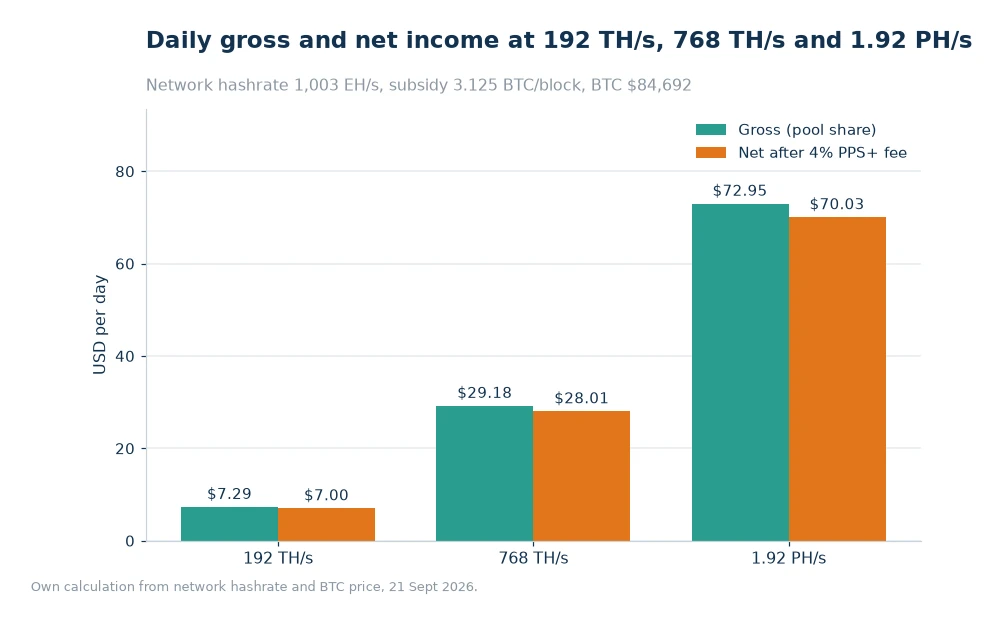
A miner's power draw is quoted at the wall, but the room pays twice: once for the boards and once for moving the heat they produce. At 192 TH/s the pool credits $7.29 a day, $7.00 after the listed 4% on the block-reward component, and the machine itself consumes about $5.53 of electricity at 20 J/TH. Cooling overhead of 20% adds $1.11, which leaves roughly 37 cents. That is the whole margin, and it is decided by airflow rather than by hashrate.
Key takeaways
- 192 TH/s earns $7.29 a day gross and $7.00 after the listed 4%, before any cooling is paid for.
- Cooling overhead of 10%, 20% or 30% of IT power changes the daily remainder from $0.92 to a small loss.
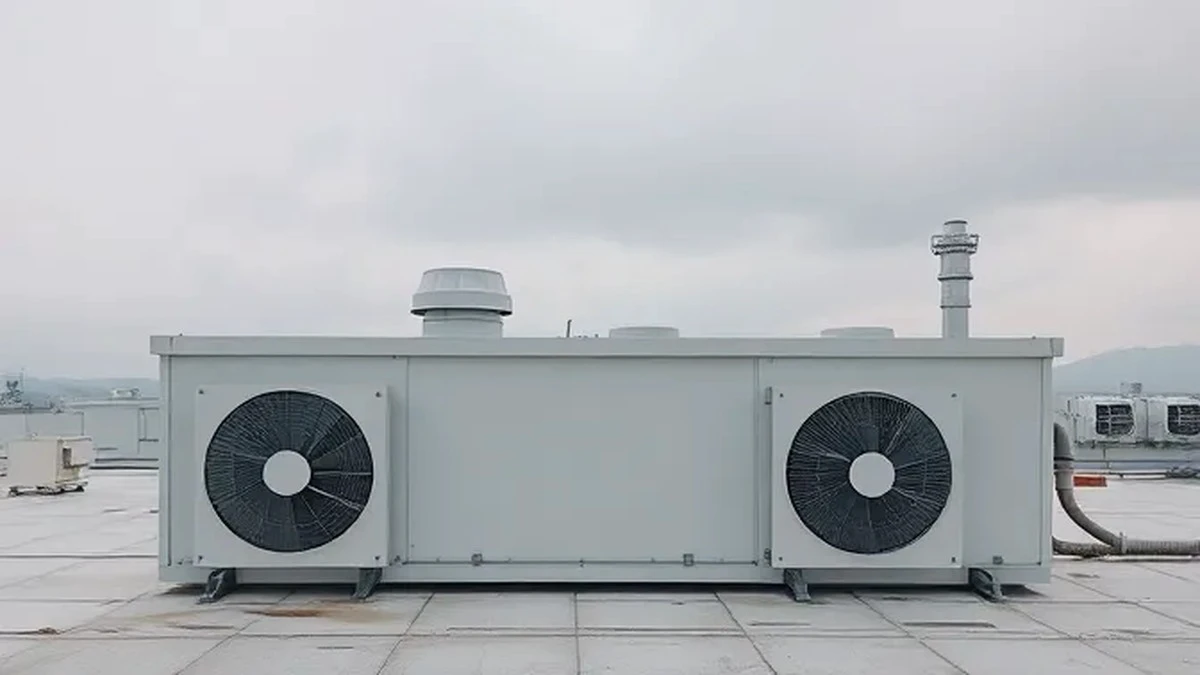
- Every kilowatt of mining hardware produces roughly the same kilowatt of heat, which must leave the room by design.
- Recirculated hot air raises intake temperature, and a board that throttles earns less without ever failing.
Where the second bill comes from
Mining hardware converts almost all of its electricity into heat, which is why a hall full of machines feels like a radiator. That heat has to move somewhere, and moving it costs fan power, pump power or compressor power depending on the design. None of it appears in a hashrate specification, and all of it appears on the utility invoice at the end of the month.
The consequence is a margin that looks comfortable on a mining calculator and thin on a bank statement. Two operators with identical machines and identical tariffs can differ by several hundred dollars a month because one ducted the exhaust outside and the other let the room cook. Cooling is not a comfort issue in this industry; it is a line item with the same weight as the power contract.
How the overhead hides in plain sight
Fans inside the machine are already counted in the wall draw, so the first layer of cooling looks free. The second layer, the room's extractor fans or air conditioning, is metered separately if it is metered at all. In a small installation it often shares a circuit with lighting and tools, which is exactly why it goes unnoticed until the summer bill arrives.
Measure it. A plug meter on the cooling circuit for a week gives a real percentage rather than a guess, and that percentage belongs in the same spreadsheet as the tariff. Ten percent is achievable with good airflow in a temperate climate; thirty percent is common in a hot room with poor ducting, and it can turn a positive margin negative at this hashrate.
Three ways to move the same heat
Open-air cooling is the cheapest to install and the hardest to control. It works when the outside air is cool and the room has a large volume, and it fails in summer or in a sealed space where exhaust air recirculates. Containment, which separates intake from exhaust, usually cuts the overhead substantially for a modest build cost because the same fan moves more useful air.
Immersion cooling puts boards in a dielectric fluid and moves heat to a loop, which can be efficient and quiet but adds pumps, fluid and maintenance routines that a small operator may not want. The choice is not about which technology is better in the abstract; it is about which one fits the climate, the building and the amount of attention available each week.
What the heat can offset
In a cold climate, exhaust heat can warm a workshop or a greenhouse instead of being dumped outside. That does not reduce the mining bill, but it displaces a heating bill that would otherwise exist, which improves the overall economics of the site. The plumbing is simple and the benefit is seasonal, so it rarely justifies a build on its own and often justifies a duct that was going to be installed anyway.
Be careful with the accounting. Heat reuse is easy to overstate because the alternative cost is hard to measure. Count only the fuel or electricity actually avoided, and only for the months when the heating would have run. A figure that survives that test is worth putting in the plan.
Sizing the room around the machines
Airflow design starts with a number: cubic meters per minute needed to keep the intake below the manufacturer's limit at full load. From there the duct size, the fan rating and the louver area follow. Installing machines first and discovering the airflow limit afterwards is the most expensive order of operations, because the correction usually involves the building rather than the hardware.
Temperature sensors at the intake and the exhaust turn the design into something measurable. Whether the site earns through ViaBTC Mining Pool or anywhere else makes no difference to the airflow, but the daily credit is what eventually pays for the fix. A rising intake over a week is a warning that filters are clogged or that hot air is short-circuiting back into the room. Both are cheap to fix and expensive to ignore, since throttling is silent. Log the readings next to the daily credit and the two curves will tell you whether an airflow change actually helped.
Three cooling overheads at one hashrate
The table holds the machine constant at 192 TH/s, 20 J/TH and $0.06/kWh, then varies only the cooling overhead. The final column is what remains after the listed pool fee, IT power and cooling are all paid.
| Cooling overhead | Cooling kWh | Cooling cost | Left over |
|---|---|---|---|
| 10% of IT power | 9.22 | $0.55 | $0.92 |
| 20% of IT power | 18.43 | $1.11 | $0.37 |
| 30% of IT power | 27.65 | $1.66 | −$0.19 |
Worked example
Follow 192 TH/s from the network share down to the margin after cooling.
- Every terahash earns 450 ÷ 1,003,000,000 = 0.00000044865 BTC a day at these inputs.
- 192 TH/s: 192 × 0.00000044865 = 0.0000861408 BTC a day.
- Gross dollars: 0.0000861408 × 84,692 = $7.2955, rounded to $7.29.
- After the listed 4%: 7.2955 × 0.96 = $7.0037, rounded to $7.00.
- IT power at 20 J/TH: 192 × 20 = 3,840 W; 3.84 kW × 24 = 92.16 kWh; × $0.06 = $5.5296.
- Cooling at 10%: 9.216 kWh × $0.06 = $0.5530; remainder 7.0037 − 5.5296 − 0.5530 = $0.9211.
- Cooling at 30%: 27.648 kWh × $0.06 = $1.6589; remainder 7.0037 − 5.5296 − 1.6589 = −$0.1848.
- At 1.92 PH/s every line is ten times larger, including the deficit.
Frequently asked questions
How much does cooling add to a mining bill?
It depends on the design and the climate. As a share of IT power, 10% is a well-ducted temperate installation, 20% is common, and 30% describes a hot room where the same air is being moved twice.
At what point does cooling erase the margin?
At 192 TH/s with 20 J/TH and $0.06/kWh, an overhead near 28% of IT power takes the daily remainder to zero after the listed 4% pool fee. Above that, the machine runs at a loss even while it produces coins.
Does heat reuse reduce the power bill?
Not the mining bill. It displaces heating costs elsewhere on the site, and only during the months when heating would otherwise run, so it should be counted as an offset rather than as a discount on electricity.
Measure the exhaust before buying another machine
Put a meter on the cooling circuit for a week and an intake sensor in the aisle. If the overhead is above 20% or the intake climbs by more than a few degrees across the day, fixing the airflow will return more than a new machine at this hashrate. The Profit Calculator restates the daily income at any hashrate, and the hosting listings under Mining Farms are worth reading if the building, rather than the hardware, has become the limit. Everything above assumes continuous uptime at current difficulty, with the listed 4% already deducted.
Chain readings of 21 Sept 2026 supply every number here: 1,003 EH/s, 132.76 T, 3.125 BTC per block and a coin price of $84,692[1]. Published 24 Oct 2026. Efficiency, tariff and cooling percentages are assumptions used for comparison, not measurements of any site.