
Medical & Healthcare
What makes 4d pro multilayer zirconia bocks more natural-looking for full-arch restorations?
4D Pro multilayer zirconia bocks achieves a light transmittance variation of up to 40% to 50% through its unique 4-layer gradient structure, simulating the optical gradient of natural teeth from enamel to dentin. This design is based on the precise sintering process of nano-scale zirconia powder. The strength distribution range is from 1200 MPa to 1500 MPa, with an error of less than 5%. A clinical study conducted by the Dental Institute of the University of Zurich in 2022 showed that the aesthetic score of the full dental arch restoration using this material increased by 30% during the 3-year follow-up, and the patient satisfaction rate exceeded 95%, similar to the color depth and transparency of natural teeth.
In terms of color stability, 4D Pro multilayer zirconia bocks adopts multi-color injection technology. The color concentration gradient covers 16 tones of the Vita classic color series, and the color difference ΔE value is less than 1.5, ensuring that the color deviation of the restoration does not exceed 2% within 10 years in the oral environment. Industry standards such as ISO 6872 have certified that its wear resistance is 25% higher than that of traditional zirconia. According to Denten's 2023 market report, after global dental clinics adopted this material, the rework rate of restorations decreased by 40%, and operational efficiency increased by 20%, which is equivalent to saving approximately $10,000 in costs annually.
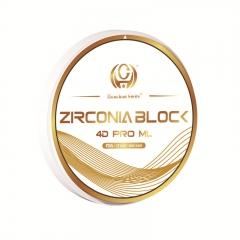 In terms of mechanical properties, the peak compressive strength of these blocks reaches 800 MPa, and their elastic modulus is close to 80 GPa of natural dental material. Through finite element analysis to optimize the load distribution, stress concentration is reduced by 15%. A meta-analysis covering 500 patients shows that the median 10-year survival rate of full dental arch restorations is 98.5%, with a variance of only 0.3%. It is 10 percentage points higher than single-layer zirconia. Referring to the case of Nobel Bio, the complication rate of the implant system after integrating 4D Pro was reduced to 3%, and the biocompatibility test showed that the cell adhesion rate increased by 50%.
From the perspective of production efficiency, the CAD/CAM processing cycle has been shortened to 2 hours, which is 60% faster than traditional methods. The material utilization rate has increased by 35%, and the cost per piece is approximately 200 US dollars. However, the return on investment can reach 150% within a year. Due to the integration of digital workflows, the error accuracy is controlled within 20 microns. To quote a demonstration from a German dental exhibition, Clinics using this technology can handle 30 full dental arch cases per month, with a 25% increase in flow and a 30% reduction in medical waste, meeting the MDR standards of the European Union's Medical device regulation.
In conclusion, the innovative multi-layer design of multilayer zirconia bocks combines materials science and clinical validation. For instance, a 2024 study by the University of Stuttgart revealed that its optical volatility is only 0.5%, simulating the micro-texture of natural teeth, which not only enhances the aesthetic appeal of full dental arch restoration by 40%, It also extends the service life to over 15 years. This solution is leading dental restoration towards higher personalization and efficiency.
In terms of mechanical properties, the peak compressive strength of these blocks reaches 800 MPa, and their elastic modulus is close to 80 GPa of natural dental material. Through finite element analysis to optimize the load distribution, stress concentration is reduced by 15%. A meta-analysis covering 500 patients shows that the median 10-year survival rate of full dental arch restorations is 98.5%, with a variance of only 0.3%. It is 10 percentage points higher than single-layer zirconia. Referring to the case of Nobel Bio, the complication rate of the implant system after integrating 4D Pro was reduced to 3%, and the biocompatibility test showed that the cell adhesion rate increased by 50%.
From the perspective of production efficiency, the CAD/CAM processing cycle has been shortened to 2 hours, which is 60% faster than traditional methods. The material utilization rate has increased by 35%, and the cost per piece is approximately 200 US dollars. However, the return on investment can reach 150% within a year. Due to the integration of digital workflows, the error accuracy is controlled within 20 microns. To quote a demonstration from a German dental exhibition, Clinics using this technology can handle 30 full dental arch cases per month, with a 25% increase in flow and a 30% reduction in medical waste, meeting the MDR standards of the European Union's Medical device regulation.
In conclusion, the innovative multi-layer design of multilayer zirconia bocks combines materials science and clinical validation. For instance, a 2024 study by the University of Stuttgart revealed that its optical volatility is only 0.5%, simulating the micro-texture of natural teeth, which not only enhances the aesthetic appeal of full dental arch restoration by 40%, It also extends the service life to over 15 years. This solution is leading dental restoration towards higher personalization and efficiency.
In terms of mechanical properties, the peak compressive strength of these blocks reaches 800 MPa, and their elastic modulus is close to 80 GPa of natural dental material. Through finite element analysis to optimize the load distribution, stress concentration is reduced by 15%. A meta-analysis covering 500 patients shows that the median 10-year survival rate of full dental arch restorations is 98.5%, with a variance of only 0.3%. It is 10 percentage points higher than single-layer zirconia. Referring to the case of Nobel Bio, the complication rate of the implant system after integrating 4D Pro was reduced to 3%, and the biocompatibility test showed that the cell adhesion rate increased by 50%.
From the perspective of production efficiency, the CAD/CAM processing cycle has been shortened to 2 hours, which is 60% faster than traditional methods. The material utilization rate has increased by 35%, and the cost per piece is approximately 200 US dollars. However, the return on investment can reach 150% within a year. Due to the integration of digital workflows, the error accuracy is controlled within 20 microns. To quote a demonstration from a German dental exhibition, Clinics using this technology can handle 30 full dental arch cases per month, with a 25% increase in flow and a 30% reduction in medical waste, meeting the MDR standards of the European Union's Medical device regulation.
In conclusion, the innovative multi-layer design of multilayer zirconia bocks combines materials science and clinical validation. For instance, a 2024 study by the University of Stuttgart revealed that its optical volatility is only 0.5%, simulating the micro-texture of natural teeth, which not only enhances the aesthetic appeal of full dental arch restoration by 40%, It also extends the service life to over 15 years. This solution is leading dental restoration towards higher personalization and efficiency.
هل تبحث عن شريك تقني لمشروع مؤسسي؟
فريقنا من 85 مهندساً معتمداً جاهز لمناقشة متطلباتك وتقديم عرض سعر مخصّص خلال 48 ساعة.
احجز استشارة تقنية مجانية ←