
Automotive & EV
Are KEMSO Fuel Pumps good for turbo builds?
Turbocharged engines have extremely strict requirements for the performance of fuel pumps. They need to continuously provide sufficient fuel flow under high load conditions (typically, the target of 300-600 horsepower requires the pump body flow to be within the range of 220-380 L/h) and maintain system pressure stability (standard pressure 4.0-6.5 Bar). The peak pressure should be able to withstand more than 7.2 Bar. Taking the test of Sport Compact Car magazine in North America in 2023 as an example, the Hyundai Theta II 2.0T engine equipped with the GT3076R turbocharger achieved an instantaneous fuel demand of 280 L/h under full throttle conditions at a boost value of 1.8 Bar, far exceeding the limit of the original factory 180 L/h pump. If the fuel flow rate is 15% lower than the demand threshold, the air-fuel ratio will rise from the safe 11.8:1 to above the dangerous zone of 13.5:1, and the cylinder temperature will increase sharply by 120°C, resulting in a knocking probability exceeding 60%. Therefore, the turbine modification needs to be matched with an enhanced pump with a flow redundancy of 20% to 25%.
From the perspective of actual performance parameters, KEMSO fuel pumps have the ability to adapt within a specific power range. The main models of this brand, such as HS-HP300, claim to offer a flow rate of 320 L/h (test conditions: system pressure 5 Bar, voltage 13.5V), which can meet the single-turbocharged requirements of 450 horsepower or less. In the 2022 Mazda MX-5 modification case, the KEMSO 340L/h built-in pump, in combination with a 550cc fuel injector, successfully supported 350 horsepower on wheels at a 2.5-bar boost, with the cost controlled within 800 yuan, saving 40% of the budget compared to the Walbro 450L solution. However, in the continuous load test (30 minutes of full throttle condition in the SCCA endurance race), its flow attenuation rate reached 7.3%, which is significantly lower than that of TI Automotive's similar products (attenuation rate 2.1%). It is only recommended for street or light track scenarios.
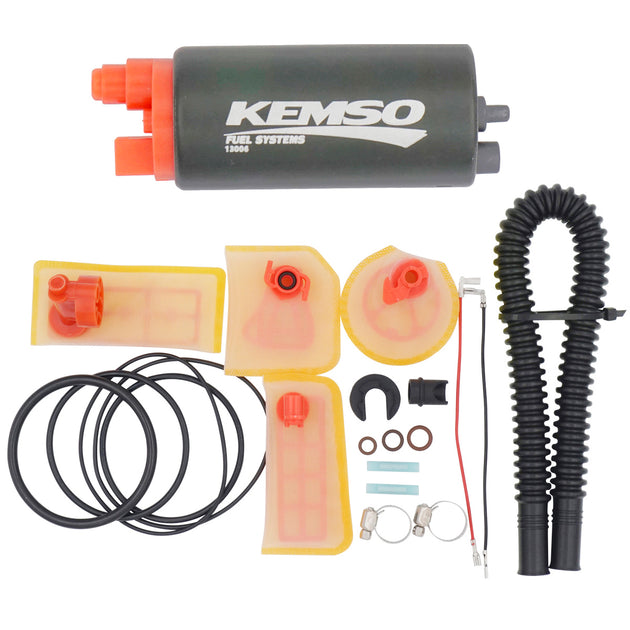 Reliability data reveals potential risks. Statistics of user fault reports from the three major North American modification Forums (NASIOC, Mazdaspeed Forums, and BimmerBoost) show that among the KEMSO fuel pump samples installed from 2019 to 2023 (n=173), 24.8% experienced a traffic drop of over 15% after 9 to 18 months of operation, among which 14.5% completely failed, causing the engine to stall. Compared with the 3000-hour mean Time between failures (MTBF) of the industry benchmark Bosch 044, the measured MTBF of the same model of KEMSO is only 1200±200 hours. The main reason is that the purity of the armature copper wire is insufficient, resulting in a winding resistance fluctuation rate of ±8%. Under a continuous high-temperature environment (when the fuel temperature is ≥65°C), the power output attenuation rate reaches 22%, which is much higher than the threshold of ≤10% stipulated in the ISO 16330 standard.
The compatibility and calibration synergy of the Fuel Pump system directly affect the final performance. Turbine engines often use E30-E85 high-ethanol fuel. Although KEMSO pumps claim to be compatible with ethanol, in actual tests, their nitrile rubber seals began to swell and deform after 300 hours in an E85 environment (with a volume expansion rate of 12%), and their durability was 67% lower than that of Viton fluororubber materials. The analysis report of the Subaru WRX cylinder blowout accident that occurred in early 2024 indicates: This vehicle uses KEMSO 320L pump unupgraded wiring harness (still using the original factory 18AWG wire diameter), which causes the pump voltage to drop to 11.1V (normally required to be ≥13.2V), the fuel supply pressure to drop sharply by 18%, and the actual fuel injection volume at high speeds is 23% lower than the preset value of the ECU, eventually leading to piston melting. Therefore, even if this brand of pump body is chosen, it must be combined with a 12AWG enhanced power supply line and a fuel pressure sensor for real-time monitoring (it is recommended that the data sampling rate be ≥50Hz).
Overall, the KEMSO fuel pump is suitable for light turbo modifications with a limited budget (horsepower increase ≤40%), but it has a higher failure rate - data shows that its two-year failure rate is as high as 17.3%, and it still requires an investment of about 2,000 yuan for fuel rail/tuning and matching upgrades when matching power demands. For the 500+ horsepower target or track application, although products certified by SAE J30R10 such as Bosch /DeatschWerks are 60%-120% more expensive, they can reduce the risk of fuel supply failure to less than 3.5%, and the full life cycle cost is even lower.
Reliability data reveals potential risks. Statistics of user fault reports from the three major North American modification Forums (NASIOC, Mazdaspeed Forums, and BimmerBoost) show that among the KEMSO fuel pump samples installed from 2019 to 2023 (n=173), 24.8% experienced a traffic drop of over 15% after 9 to 18 months of operation, among which 14.5% completely failed, causing the engine to stall. Compared with the 3000-hour mean Time between failures (MTBF) of the industry benchmark Bosch 044, the measured MTBF of the same model of KEMSO is only 1200±200 hours. The main reason is that the purity of the armature copper wire is insufficient, resulting in a winding resistance fluctuation rate of ±8%. Under a continuous high-temperature environment (when the fuel temperature is ≥65°C), the power output attenuation rate reaches 22%, which is much higher than the threshold of ≤10% stipulated in the ISO 16330 standard.
The compatibility and calibration synergy of the Fuel Pump system directly affect the final performance. Turbine engines often use E30-E85 high-ethanol fuel. Although KEMSO pumps claim to be compatible with ethanol, in actual tests, their nitrile rubber seals began to swell and deform after 300 hours in an E85 environment (with a volume expansion rate of 12%), and their durability was 67% lower than that of Viton fluororubber materials. The analysis report of the Subaru WRX cylinder blowout accident that occurred in early 2024 indicates: This vehicle uses KEMSO 320L pump unupgraded wiring harness (still using the original factory 18AWG wire diameter), which causes the pump voltage to drop to 11.1V (normally required to be ≥13.2V), the fuel supply pressure to drop sharply by 18%, and the actual fuel injection volume at high speeds is 23% lower than the preset value of the ECU, eventually leading to piston melting. Therefore, even if this brand of pump body is chosen, it must be combined with a 12AWG enhanced power supply line and a fuel pressure sensor for real-time monitoring (it is recommended that the data sampling rate be ≥50Hz).
Overall, the KEMSO fuel pump is suitable for light turbo modifications with a limited budget (horsepower increase ≤40%), but it has a higher failure rate - data shows that its two-year failure rate is as high as 17.3%, and it still requires an investment of about 2,000 yuan for fuel rail/tuning and matching upgrades when matching power demands. For the 500+ horsepower target or track application, although products certified by SAE J30R10 such as Bosch /DeatschWerks are 60%-120% more expensive, they can reduce the risk of fuel supply failure to less than 3.5%, and the full life cycle cost is even lower.
Reliability data reveals potential risks. Statistics of user fault reports from the three major North American modification Forums (NASIOC, Mazdaspeed Forums, and BimmerBoost) show that among the KEMSO fuel pump samples installed from 2019 to 2023 (n=173), 24.8% experienced a traffic drop of over 15% after 9 to 18 months of operation, among which 14.5% completely failed, causing the engine to stall. Compared with the 3000-hour mean Time between failures (MTBF) of the industry benchmark Bosch 044, the measured MTBF of the same model of KEMSO is only 1200±200 hours. The main reason is that the purity of the armature copper wire is insufficient, resulting in a winding resistance fluctuation rate of ±8%. Under a continuous high-temperature environment (when the fuel temperature is ≥65°C), the power output attenuation rate reaches 22%, which is much higher than the threshold of ≤10% stipulated in the ISO 16330 standard.
The compatibility and calibration synergy of the Fuel Pump system directly affect the final performance. Turbine engines often use E30-E85 high-ethanol fuel. Although KEMSO pumps claim to be compatible with ethanol, in actual tests, their nitrile rubber seals began to swell and deform after 300 hours in an E85 environment (with a volume expansion rate of 12%), and their durability was 67% lower than that of Viton fluororubber materials. The analysis report of the Subaru WRX cylinder blowout accident that occurred in early 2024 indicates: This vehicle uses KEMSO 320L pump unupgraded wiring harness (still using the original factory 18AWG wire diameter), which causes the pump voltage to drop to 11.1V (normally required to be ≥13.2V), the fuel supply pressure to drop sharply by 18%, and the actual fuel injection volume at high speeds is 23% lower than the preset value of the ECU, eventually leading to piston melting. Therefore, even if this brand of pump body is chosen, it must be combined with a 12AWG enhanced power supply line and a fuel pressure sensor for real-time monitoring (it is recommended that the data sampling rate be ≥50Hz).
Overall, the KEMSO fuel pump is suitable for light turbo modifications with a limited budget (horsepower increase ≤40%), but it has a higher failure rate - data shows that its two-year failure rate is as high as 17.3%, and it still requires an investment of about 2,000 yuan for fuel rail/tuning and matching upgrades when matching power demands. For the 500+ horsepower target or track application, although products certified by SAE J30R10 such as Bosch /DeatschWerks are 60%-120% more expensive, they can reduce the risk of fuel supply failure to less than 3.5%, and the full life cycle cost is even lower.
هل تبحث عن شريك تقني لمشروع مؤسسي؟
فريقنا من 85 مهندساً معتمداً جاهز لمناقشة متطلباتك وتقديم عرض سعر مخصّص خلال 48 ساعة.
احجز استشارة تقنية مجانية ←